
The Science Behind A1 and A2 Milk
… Most of us grew up believing that milk was milk. White, nutritious, wholesome. But over the last two decades, a growing body of research has begun asking a more precise question: which kind of milk protein are you actually drinking — and does the answer change how your body responds to it?
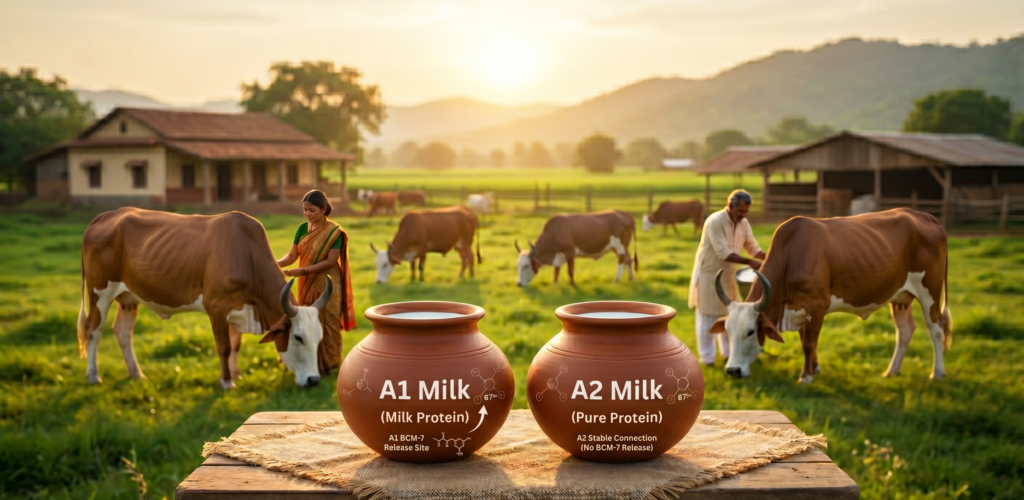

The difference comes down to a single amino acid in a single protein. That tiny molecular distinction, it turns out, has potentially wide-ranging effects on your gut, your immune system, and possibly even your brain. The protein in question is beta-casein, and it comes in two forms: A1 and A2. Understanding the difference between them is one of the most practically useful things you can know about the dairy you consume.
First, a quick genetics lesson
Milk is roughly 80% casein protein and 20% whey protein. Of the casein, about a third to half is beta-casein. In the wild, cows originally produced only the A2 form of this protein — the same form found in human breast milk, and the milk of native Indian cow breeds (colloquially referred to as Desi Cows).
Then, somewhere around 5,000 to 10,000 years ago, a genetic mutation occurred in herds of Northern European cattle. At position 67 of the beta-casein protein chain, the amino acid proline was swapped out for histidine. That’s it. One amino acid. The result was A1 beta-casein — a slightly different protein that, crucially, breaks down differently inside the human digestive tract.
As European cattle breeds like Holstein, Friesian, and Ayrshire spread globally to become the world’s dominant dairy producers, A1 beta-casein came along with them. Today, the vast majority of commercially sold cow’s milk contains a mixture of both A1 and A2 proteins, with A1 often predominating.
The core mechanism — BCM-7
When A1 beta-casein is digested, that single amino acid difference (histidine instead of proline at position 67) means the protein chain breaks apart more easily at that location. This releases a small but biologically active peptide called beta-casomorphin-7 (BCM-7).
A2 beta-casein, by contrast, has proline at that position — which creates a stronger molecular bond that resists breaking. A2 milk produces little to no BCM-7 during digestion. This is the crux of the entire A1 vs. A2 debate.
BCM-7 is an opioid peptide — meaning it has a structural resemblance to opiates and can bind to opioid receptors throughout the body: in the gut wall, the immune system, and, in certain circumstances, even the brain. Its presence after digestion is the reason researchers have been asking hard questions about A1 milk for decades.
“BCM-7 concentration is approximately four times higher in hydrolyzed A1 milk than in A2 milk.”
— Food & Health Journal, 2021
The issues with A1 milk
Let’s walk through what the science has observed so far, issue by issue.
01
Digestive distress — and it’s not what you think
Millions of people avoid dairy because they assume they’re lactose intolerant. But a landmark 2016 study published in Nutrition Journal challenged that assumption in a striking way. Participants who reported intolerance to conventional cow’s milk were given either standard A1/A2 milk or pure A2 milk in a double-blind crossover design. When drinking A1 milk, they experienced classic dairy discomfort symptoms — bloating, pain, gas, digestive distress. When switched to A2 milk, their symptoms largely disappeared.
The researchers ruled out lactose as the culprit. Both milks contained the same lactose. The variable was the beta-casein type — specifically, the BCM-7 released by A1. The peptide slows gut motility (the muscular contractions that move food along), increases mucus secretion, and appears to interfere with lactase production, the enzyme you need to digest lactose. In other words, A1 milk may be making people appear lactose intolerant when they are actually reacting to the protein.
Study reference
He M, et al. (2016). Effects of milk containing only A2 beta casein versus milk containing both A1 and A2 beta casein proteins on gastrointestinal physiology, symptoms of discomfort, and cognitive behavior. Nutrition Journal, 15, 35. The study used a “smart pill” capsule to directly measure gut transit time and inflammation — not just self-reported symptoms.
02
Gut inflammation and your microbiome
Your gut is home to trillions of bacteria that influence everything from your immunity to your mood. A 2025 randomized double-blind crossover study from Seoul National University Bundang Hospital, published in PLOS ONE, examined what happened to the gut microbiome of Korean participants who experienced discomfort after drinking regular milk. When switched to A2 milk, participants showed measurable improvements in gastrointestinal symptom scores and reduced levels of fecal calprotectin — a well-established biomarker of intestinal inflammation.
A broader 2025 review in Applied Sciences that analyzed human studies across different populations — children, middle-aged adults, and athletes — found that A1 beta-casein consumption was associated with altered gut microbial composition, reduced intestinal motility, increased colonic fermentation, elevated gas production, and disrupted short-chain fatty acid (SCFA) profiles. SCFAs like butyrate and acetate are critical for colon health, reducing inflammation, and feeding the gut lining itself.
Study reference
Kwon et al. (2025). Beneficial effect of consuming milk containing only A2 beta-casein on gut microbiota. PLOS ONE. Also: A 2019 study in Chinese preschoolers (published in Journal of Pediatric Gastroenterology & Nutrition) found that when children consumed regular milk, inflammatory markers including interleukin-4 and immunoglobulin levels were significantly elevated — changes not seen with A2 milk.
03
Intestinal barrier integrity — “leaky gut”
The gut lining is a selective barrier. It lets nutrients in while keeping pathogens and waste products out. BCM-7 from A1 beta-casein appears to compromise this barrier. A comprehensive 2025 review in Applied Sciences notes that BCM-7 can “compromise intestinal-barrier integrity” — meaning it may contribute to what researchers call increased intestinal permeability, or colloquially, “leaky gut.”
When the gut barrier is compromised, partially digested food particles and bacterial byproducts can pass into the bloodstream, triggering immune responses and systemic inflammation. This mechanism could help explain why some people with irritable bowel syndrome (IBS), food sensitivities, and allergic conditions find that they react to dairy even when lactose isn’t the issue.
Study reference
Comprehensive review: The Impact of A1- and A2 β-Casein on Health Outcomes: A Comprehensive Review of Evidence from Human Studies. Applied Sciences, June 2025 (MDPI). The paper integrates gastrointestinal, immunological, and neurological evidence on BCM-7’s effects via what it terms the “gut-neural axis.”
04
Neurological concerns — crossing the blood-brain barrier
BCM-7 is named a casomorphin for a reason: it behaves like a mild opiate. In susceptible individuals — particularly those with increased gut permeability — BCM-7 may be absorbed into the bloodstream and potentially cross the blood-brain barrier, where it can bind to opioid receptors in the brain.
Researchers have proposed links between BCM-7 accumulation in the brain and neurological and behavioural conditions, including autism spectrum disorder, schizophrenia, ADHD, and Alzheimer’s disease. The hypothesis, sometimes called the “opioid excess theory,” suggests that in individuals with poor gut barrier function and reduced peptide-breaking enzyme activity, opioid peptides like BCM-7 accumulate in the bloodstream and brain, potentially disrupting the opioid and neurotransmitter systems.
It is critical to be clear here: these links are not yet proven in controlled human trials. Most of the evidence is observational, based on animal models, or limited in scope. Researchers at Nature’s npj Science of Food (2026) note directly that “most studies linking BCM-7 to autism or neurological disorders are observational, dated, or based on animal models; causality remains unproven.” That said, the plausibility of the mechanism — a gut-permeable opioid peptide reaching the brain — is taken seriously enough to warrant continued research.
Study reference
Cieślińska A, et al. (2022). Review of BCM-7 opioid receptor binding and neurological system effects. The 2025 Applied Sciences review also integrates neurological evidence, noting BCM-7’s “ability to cross the blood-brain barrier raises concerns about potential neurological effects” and calls for urgent further study in vulnerable populations.
05
Type 1 diabetes and immune disruption
One of the earliest and most controversial claims about A1 milk involves type 1 diabetes — an autoimmune condition in which the immune system destroys the insulin-producing beta cells of the pancreas. The proposed mechanism: BCM-7 is thought to target pancreatic beta cells, potentially triggering autoimmune destruction. It also interacts with both T and B immune cells, which could dysregulate the broader immune system.
Epidemiological studies and some animal research have found correlations between A1 beta-casein consumption and higher rates of type 1 diabetes in certain populations. However, a more recent study on chemically-induced diabetic adult rats found no significant effect of A1 or A2 casein on pancreatic function, complicating the picture. Researchers note that differences in pre-existing health conditions may trigger different physiological responses under BCM-7 exposure — meaning not everyone is equally susceptible.
Study reference
What makes A2 milk different
A2 milk is simply milk that comes exclusively from cows that carry two copies of the A2 gene variant — meaning their beta-casein is entirely the original A2 form, producing no BCM-7 upon digestion. These cows are identified through genetic testing. Many older and indigenous breeds — most South Asian and African cattle — naturally produce predominantly or exclusively A2 milk. There are 51 Desi Cow breeds registered by ICAR-NBAGR (National Bureau of Animal Genetic Resources), Karnal.
Across human trials, A2 milk has been consistently associated with:

Better gut comfort. Reduced bloating, gas, abdominal pain, and constipation compared to regular milk in people with self-reported milk sensitivity.

Lower intestinal inflammation. Reduced fecal calprotectin — the inflammation biomarker — after switching from regular to A2 milk.

Healthier microbiome. Higher levels of beneficial bacteria like Bifidobacterium species, and better short-chain fatty acid profiles, indicating improved colon health.

Fewer immune reactions. In a study of Chinese preschoolers, inflammatory immune markers elevated by regular milk were not triggered by A2 milk.

No cognitive impairment. The 2016 He et al. trial found that A1 milk reduced cognitive processing speed — an effect not seen with A2 milk, likely due to reduced systemic inflammation.
Nutritionally, A2 milk is identical to regular milk. Same calcium, same protein quantity, same fat, same vitamins. The only difference is the structure of the beta-casein protein — and the cascade of effects that flows from it.
A note on Indian cattle — an ancient A2 advantage
India has one of the oldest dairy cultures in the world, and there is a reason the milk from Indian indigenous breeds like the Belahi, Gir, Sahiwal, Red Sindhi, Tharparkar, and others has been valued for centuries in Ayurveda and traditional medicine. Research has confirmed that Indian native dairy cattle naturally carry only the A2 allele. They never underwent the Northern European mutation. The milk they produce is inherently A2.
As India’s dairy sector modernised and crossbreeding with European Holstein and Jersey cattle became common, A1 beta-casein entered the milk supply. Many health practitioners and traditional dairy advocates in India have pointed to this shift as a potential contributor to rising rates of lifestyle-related and autoimmune diseases — though establishing direct causation from epidemiological data alone is complex.
Should you switch?
Two systems of inquiry — separated by millennia, using entirely different methods — have arrived at the same place. The ancient physicians of India described the milk of the indigenous cow as unlike any other. Modern biochemistry identified a single amino acid at position 67 of the beta-casein chain and found out why.
What sits in most commercial milk cartons today is not what your grandparents drank, not what the Ayurvedic texts described, and not what human digestion evolved alongside. It is the product of a genetic mutation in Northern European cattle that spread globally because those breeds happened to produce more milk — not better milk.
“A2 milk may alleviate GI discomfort in people who experience milk-related discomfort symptoms — and the evidence is growing.”
— Journal of Cancer Prevention, 2024 (Korean clinical trial)
The body of evidence around A2 milk is not yet complete. Science rarely is. But the mechanism is understood, the human trials are consistent, and the direction of the evidence is clear. If that original form turns out to be easier on the human body — and the evidence increasingly suggests it is — then choosing A2 isn’t a trend. It’s a return.